

The bogeyhole generation
It is our responsibility

For the reasonable price of just $5 AUD per month or $50 per year, you can be a full subscriber to Filling the Pail with complete access to my extensive archive on a range of topics, as well as access to the unabridged version of my weekly Curios posts.
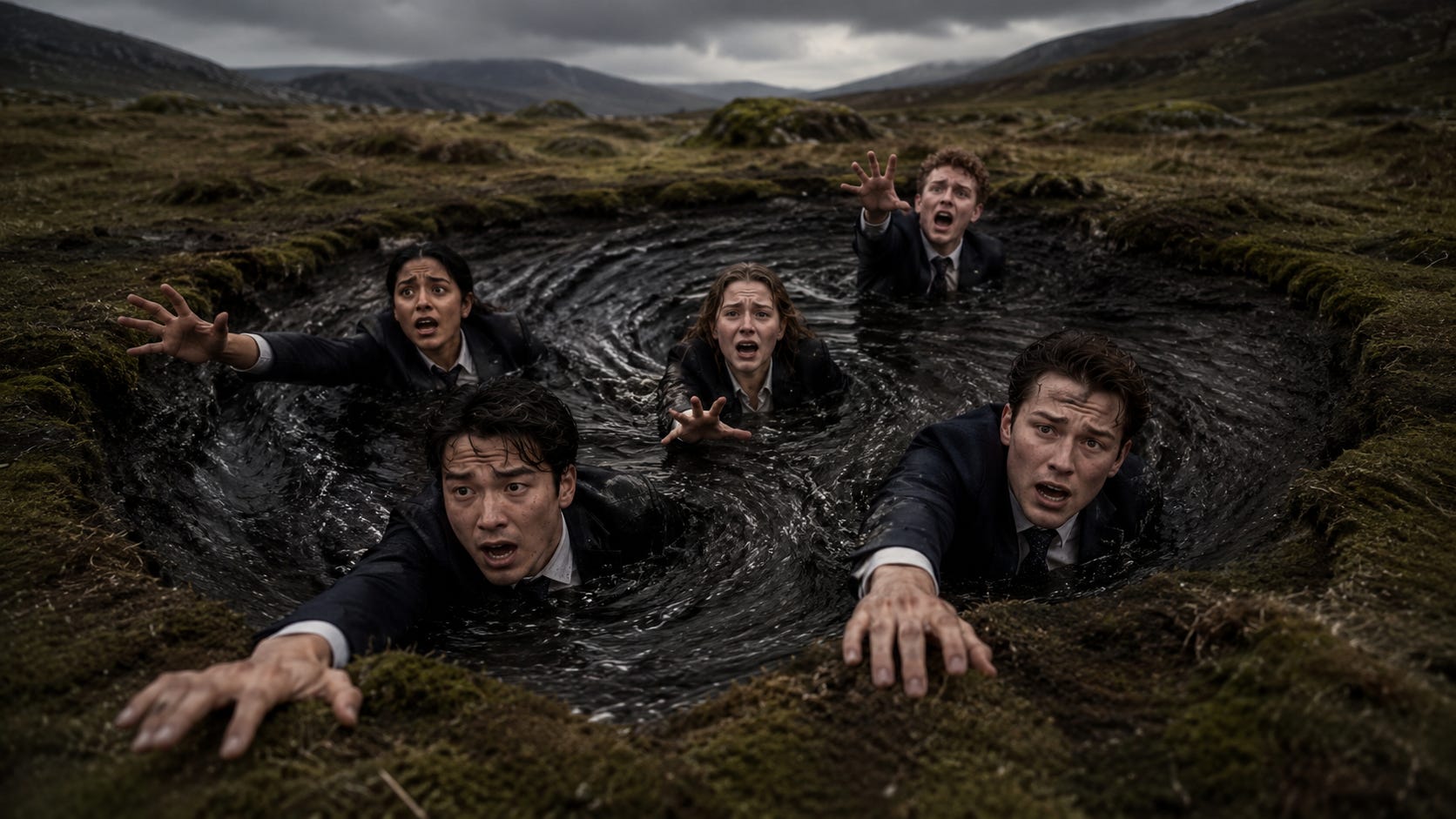
My maternal grandfather, on hearing a gloomy piece of music or viewing an overly earnest TV drama, would proclaim, “This is sending me down the bogeyhole.” A spin-off from this saying was the term “bogeyhole music” that the whole family used to express disdain for the products of musicians who should cheer up a bit. It was a class-coded term. For members of manual trades, life’s pleasures were precious enough to be grasped hungrily, with both hands. It is only the bourgeoisie who can afford the luxury of ennui, sheltered as they are from much that is hard in the world.
I fear we have created a bogeyhole generation, you and I. Sheltered as they are from much that is hard in the world, we have taught them to worry about intangibles that are out of their control. History is a bleak story of woe and reflects poorly on who we have become (whoever we are). International politics is horrific and somehow our fault. The climate is in a state of emergency. Again, our fault. Young people’s gay and trans friends are oppressed. Their autistic friends are oppressed. So much is wrong and reflects badly on us. Yet we have little control over any of it.
And to this generation, life is full of obstacles: they will never afford their own home and without their own home, they will never have children.
Really? I had teenage angst and wrote atrocious poems and songs about it. But I never thought of life in quite this way. I wanted my own home—an unlikely prospect once I moved to London in my 20s—and I wanted children, but I don’t think I ever saw the former as a prerequisite for the latter. I had grown up in a town where people living in rented council houses seemed to have no problem procreating. None whatsoever.
Indeed, my paternal grandfather lived in a rented two-up, two-down terraced house and managed to father five children. An extraordinary man, he switched trades from chain-making to bricklaying and eventually hand-built a family home. But that was after my grandparents started having children and not before.
These days, there does not seem to be enough cope to go around and this is all our fault and not the fault of young people. We have schooled them in anti-stoicism. We have told them to focus on things they have little or no control over.
Young men, in particular, have been told they are inherently rotten. If they are white and straight then they have no way out of this bind and so we have created the demand for manosphere influencers. We did that. We tell ourselves that malign forces created this market, but markets are driven by demand.
Thirty years ago, a bookish young man could fall in love with the liberal arts. He could aspire to be a bestselling novelist or maybe the next Dominic Sandbrook. Can you imagine that now? What place would he find for himself in a university history or English literature department amongst all the lamentation? I am told of young men entering the workforce who do not express their views on the least contentious of workplace matters because when they do, they are openly accused of showing their privilege.
And yet much as I would not want to be a young man now, it is often young women who seem even more lost. Caught in a world of contradictions, between ideals and desires and between actions and agency, they are told they are victims at the mercy of malevolent forces.
They are: us.
Yes, the world can be ugly and tragic. People do terrible things to each other. But the world also contains joy, excitement and the possibility of a better tomorrow.
What can we do about it? The 1980s cure for bogeyhole music was Our House or Come on Eileen. I suggest we also need some balance in the curriculum. The lens of oppression is a valid way to view the arts, but it is not the only valid way. The human experience spans more than issues of power and domination. We must also teach acerbic literature and the derring-do of history. There does not need to be a moral to every story. Sometimes, there can be a punchline. And we need to embrace a little techno-optimism in science. It’s not all building energy audits. There’s cool stuff, too.
Maybe being young is always like this and maybe I am getting old. But life has its good bits and we need to teach those, too.
Teachers in Victoria seem to consider it their duty to make our kids feel miserable. First we’ll start with an acknowledgment of country, where we “pay respects to any aboriginal people present” and implicitly atone for the sins of our ancestors. (Or, if you’re eg. a Chinese migrant to Australia, someone else’s ancestors. It’s still your fault.) Then we batter them, as you say, with climate change, housing difficulties, intersectional oppression, and instead of great works of art, we spoon feed them the warm diarrhoea of some mediocre artist who happens to be from an oppressed class.
Bella D’Abrera sets this out nicely (though depressingly) in “Mindless.”
For my part I’ll continue to teach kids the value of hard work and the opportunity that is still present in Australia for those who are prepared to try. I hope it’s enough. I’d like to directly argue against the prevailing narrative, but I’m pretty sure my school would suddenly notice “issues” with my work and call me in for a “chat.”