

researchED Melbourne returns
Science of learning on the ninth floor

For the reasonable price of just $5 AUD per month or $50 per year, you can be a full subscriber to Filling the Pail with complete access to my extensive archive on a range of topics, as well as access to the unabridged version of my weekly Curios posts.
The first researchED Melbourne took place in 2016 at Brighton Grammar and so it was fitting that it returned to the city on Saturday. For ten years I’ve worked with Tom Bennett in having an oversight role for Australian conferences. Often, I have had an organisational role, but we also agree to others putting conferences together. I then have a hand in keeping the ethos authentic.
Saturday was organised by the team at Haileybury, an Australian chain of independent schools. As I was not asked to speak, I had the refreshing experience of simply attending a researchED conference as a guest. I’m not sure I have ever actually done that before. For some reason, I had thought there were only going to be around 200 people there, but announcers on the day said it was 400. This made things interesting because Haileybury decided to run the conference in their high-rise city campus, so there was much jumping in and out of elevators and rattling down stairs.
Despite the larger numbers than I had anticipated, the conference sold out quickly due to Haileybury promoting it on LinkedIn. I announced it via the researchED Australia Twitter/X handle but was slow on promotion and realised it would not be a good idea to promote a conference that had already sold out. So, sorry to those who are not on LinkedIn. It does seem to be the place where education discussions have migrated. I need to think about this and put a better plan in place for the future. For a variety of reasons, I think we are going to see more Australian researchED conferences.
First to speak was Derek Scott, Principal of Haileybury and Chair of the board of ACARA—the body that curates the Australian Curriculum and administers NAPLAN, the national standardised assessments in literacy and numeracy. As we all sat in a large space on the ninth floor, he reminded us that Haileybury was a pioneer of explicit teaching, first trialling it in 2007/8. Then Brad Rowswell, the state shadow education minister, spoke. I suspect we would also have seen the minister if not for a recent reshuffle. Roswell was impressive—a rare politician who really knew the education brief he had been given. He has listened to Sold a Story and understood the problems with ‘guessing methods’ such as whole language and three-cueing. He referenced cognitive load theory and signalled that evidence-informed teaching was now a matter of cross-party agreement. Too often, he argued, evidence is sacrificed to ideology. He referred to research suggesting that each child costs the state $33 billion if we don’t get this right. That sounds like a lot and I suspect he misspoke.
Then Anna Stokke delivered a swift and absorbing keynote. Stokke, a Canadian professor, and I are now colleagues of sorts. She is a co-director of La Trobe University’s Science of Mathematics Education (SOME) Lab and I have just taken on a voluntary adjunct role with La Trobe. Stokke’s talk was a primer in research scepticism—what to look for and what questions to ask.
Next, there was a panel discussion involving Stokke, Jordana Hunter of the McKinnon Foundation and Joanna Barbousas of La Trobe, moderated by Anna Sever of Haileybury (I think). This fielded questions from the audience submitted through an anonymous app. The one that stood out was concern about the gender gap in NAPLAN numeracy, where boys outperform girls. Although a genuine matter of concern, I do find it interesting that this is one of five NAPLAN outcomes, with girls outperforming boys on the other four. Arguably, boys’ underperformance in literacy is a more significant issue and may be responsible for the increasing gender imbalance at university. Nevertheless, the panel tackled the question well. Stokke suggested this question tends to be asked more often in Australia than elsewhere and worried whether such issues can be a distraction, whereas Hunter noted that even though there is also a gender gap in Singapore, Singaporean girls outperform Australian boys.
It was then time for the concurrent sessions and I chose to stay to listen to Jamie Clark, the Perth teacher behind DistillED’s one-page summaries. His topic was ‘thinking hard’—a difficult one to navigate. It was a splendid primer on cognitive science and included that diagram by Oliver Caviglioli of a head with a tree growing out of it. I worry a little that desirable difficulties, the concept at the core of Clark’s talk, has been misused to argue for so-called productive struggle strategies. Clark did not argue this, but I think he could have drawn firmer boundaries around the idea.
I then watched a small panel consisting of Jordana Hunter and Matt Hood OBE. Hood is the man at the centre of everything that has happened in the last fifteen years in English education, working with an academy chain, creating Oak National Academy and founding the Ambition Institute. Apparently, this last move was in response to universities simply refusing to deliver what he wanted when working at Teach First. They could not deliver and so he built his own university to do the job instead. I like that.
Hood was, to me, something of the ghost of Christmases yet to come. We are way behind the reform agenda of England—the purpose of the panel was to expand on the multi-school organisations that have been a key component of English education for years and are now being piloted in Tasmania. Hood looks back upon things we have not yet done. And he speaks plainly and with great insight. I decided I would also attend his other session slated for later in the day.
Next was Haili Hughes—pronounced ‘high-lee’ as we all learned. Hughes is from the UK and well known at researchED conferences there. She had just started a new role as Associate Professor at… La Trobe. I didn’t catch all her talk about lethal mutations because nature called, but I had a chat with Hughes at the end of the day. She is concerned that while we learn from the successes of England, we also avoid England’s mistakes.
After the event, someone asked me about the Instructional Hierarchy and what I thought of it. I think this is an example of what Hughes is concerned about. I am nervous about applying uniform models of learning in a school, especially a universal lesson plan structure—which is how it seemed the Instructional Hierarchy was being interpreted in this case. It might suit some subjects and not others. It might suit some topics and not others. Most of these decisions cannot possibly be made at the school level and be robust. That work needs to be done by subject teams. I remember that for several years, the English teachers at my school were unsure whether mini whiteboards had anything to offer their subject. I respected that and never pushed them on it because I didn’t know. Eventually, with the help of resources such as Doug Lemov’s Teach Like a Champion videos, they began to experiment and took ownership of mini whiteboards for themselves. That’s the way it should be.
Next was more Matt Hood, this time with Emma Hickey, a top principal from England who was also visiting Australia. They discussed teacher expertise and how to develop it. Hickey explained her coaching model in some detail. It is impressive but would take a significant investment of resources. I am still thinking about what I could take from it.
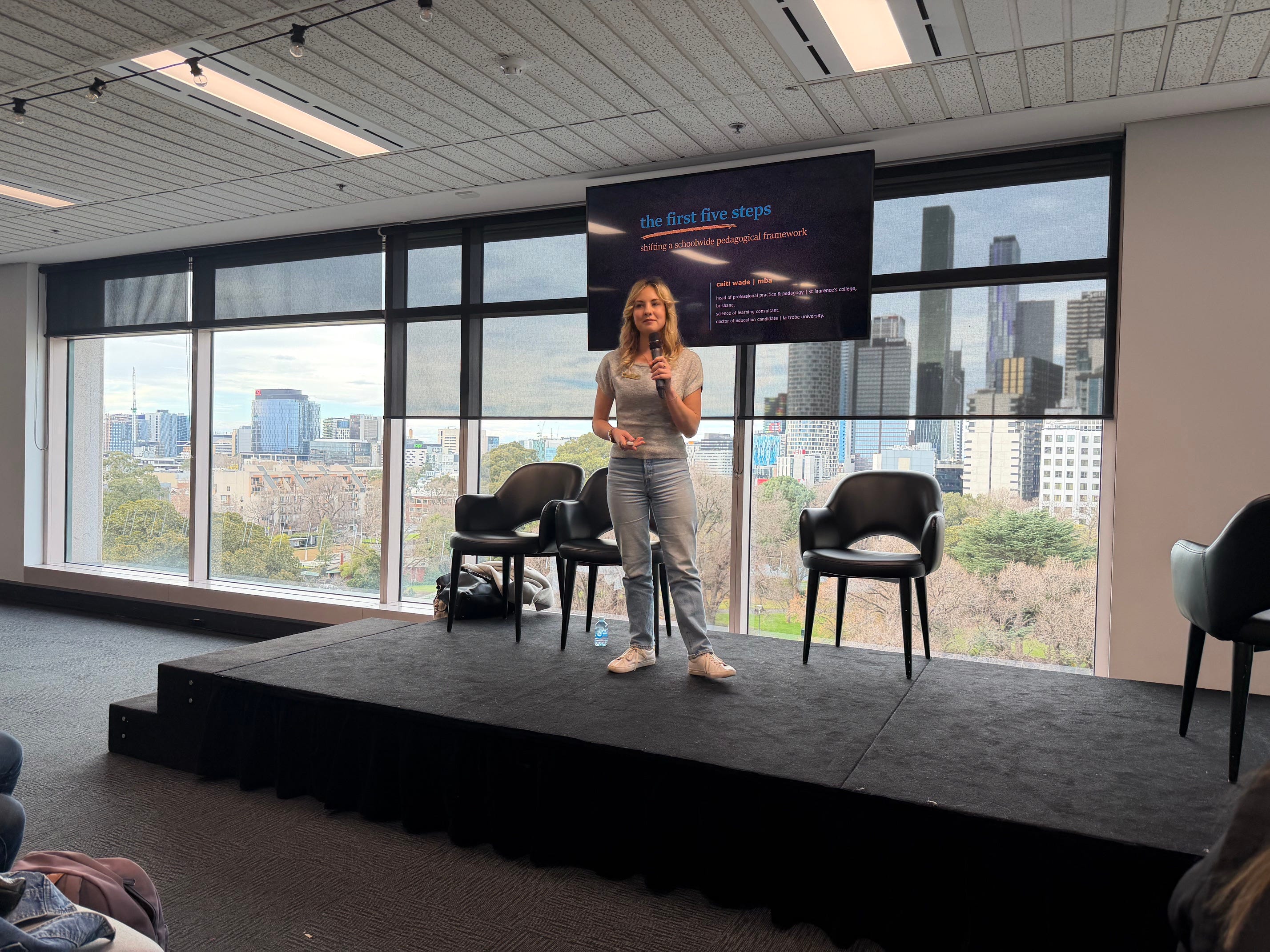
Finally, I saw my podcast co-host, Caiti Wade, give a talk on school improvement. Apparently, this was similar to the talk she gave at researchED Ballarat in March. I don’t get to sit through talks when we host—I have to flit from one to the other and snap pictures—so it was great to sit down and listen to Caiti. She is a great speaker and made a lot of sense, with some interesting overlap between her talk and my new book, How to Improve a School.
On Saturday, we saw the future. I know we will make mistakes, despite the best efforts of Haili Hughes. But those 400 people on the ninth floor have a lot of potential to improve education in this country. We already have some of the component parts. What will we build next? Where to from here?
Can’t see any reporting at all on the conference, apart from this? Unless I’ve missed it. Very interesting to have a rundown on the program and sessions but there seems to be an odd silence?