

Low floor high ceiling maths tasks are not the solution
Activity-based planning and differentiated instruction

For the reasonable price of just $5 AUD per month or $50 per year, you can be a full subscriber to Filling the Pail with complete access to my extensive archive on a range of topics, as well as access to the unabridged version of my weekly Curios posts.
I am a long-term sceptic of ‘differentiation’ or ‘differentiated instruction’. A recent article for EducationHQ quoted me to this effect, although I am unclear which blog post the quote is drawn from (the publication of this article led to a series of eccentric personal attacks on me on Twitter/X). I recently explained my scepticism about differentiation on this Substack and my position remains the same.
Problem solved
One of the key issues with differentiation as it is often understood is that it requires teachers to make different versions of the same lesson resources or plan different tasks. Given that many teachers are on the hamster wheel of planning all lessons for themselves, this acts as a further workload multiplier.
But what if there was an alternative? What if we could give all students the same task, but it was designed in such a way that they could all interact with it according to their current level of knowledge? That would seem to fix the problem of planning many different tasks, while also allowing for differentiation. Students could be grouped within the class and tackle the task differently.
Welcome to the concept of a ‘low floor/threshold high ceiling’ task. Or the related idea of a task with an ‘open middle’. Is this the solution for differentiation?
Activity-based planning
The first problem with this approach is that it does not begin with a clear idea of what we want the students to learn. It is focused on giving students something to do, rather than teaching them a specific mathematical concept. The unwritten assumption appears to be that doing something mathematical will help young people learn mathematics. The snag is that we know students can be busily completing a mathematical problem and not really learning anything much at all. This is because problem solving taxes mental resources to the extent that there is often no attention left over to notice patterns.
Instead, if we want students to learn mathematics, a planned, sequenced approach where concepts are explicitly introduced would seem to be a better bet.
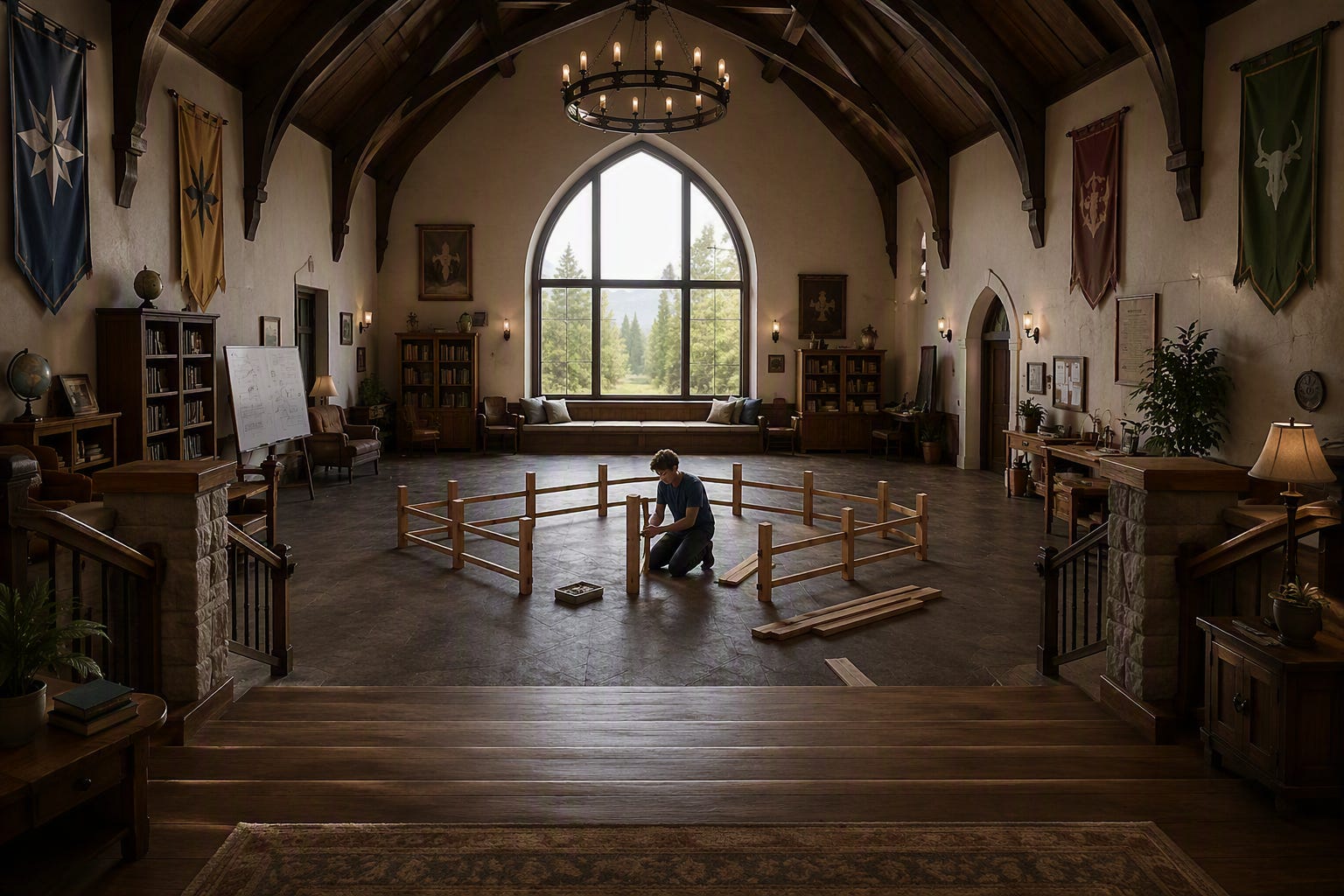
One example of a low floor high ceiling task is available on the youcubed website. It is essentially a mathematical inquiry where students need to discover, or be nudged towards discovering, the answer to the question: what is the biggest fence that can be made out of 36 pieces of fence?
Initially, I found this baffling, assuming the answer must be a fence 36 pieces long. When I went on to read more of the task, it became clear that this was about a maximum area and maybe it is intended to be a question about the largest area enclosed by the fence. This could be tackled by trial and error, modelling as a quadratic function and finding the turning point or as a basic and trivial calculus maximum/minimum problem.
I am therefore not sure exactly what mathematics this is targeting. The prompt mentions students ‘may construct models using dynamic geometric software and apply trigonometry’. I do not know what that means and I imagine that in practice, this task results in a lot of trial and error.
Thresholds
Is there a better source than youcubed? The University of Cambridge has a set of ‘nrich’ resources that are ‘low threshold high ceiling’ tasks. One task targeted at children aged 7-14 is ‘neighbourly addition’ and boils down to asking students to figure out what happens when you add three consecutive odd numbers.
At least students will practise completing a mathematical operation, albeit a very basic one, especially for 14-year-olds. From the task description, it seems they are meant to discover, or be nudged toward discovering, that the answer will always be odd and three times the middle number.
It’s not profound and strikes me as a little pointless. Unfortunately, I can see it keeping students busy for an extended period of time and I worry that may be the attraction. What is clear is that despite the framing, these tasks are cover for a form of inquiry learning.
Floored
Are these tasks therefore just inquiry learning under a new name?
For my PhD, I investigated something called productive failure. This is the idea that we give students a problem that they fail to solve using the accepted method and then we teach them that method. It is effectively the fallback position that educational psychologists who are drawn to inquiry learning have retreated into.
Manu Kapur, the researcher most closely associated with productive failure, wrote a list of conditions that need to be adhered to for it to work and one of these is that the problem must be understandable to someone with little relevant background knowledge of the concepts being taught. This is a highly significant constraint and is essentially the same constraint as a low floor/threshold.
Kapur managed this constraint in some of his work by focusing on standard deviation and asking which baseball player was the most consistent. I managed it by asking which lightbulb was the most energy saving. It was hard to come up with a task that made sense in ordinary language and went somewhere interesting rather than trivial and this is a serious limitation. Even if productive failure works—and I couldn’t get it to work—the learning objectives it can be applied to are limited in scope.
Mathematics is nothing if not hierarchical and so constraining tasks in this way ignores that hierarchy. It means they can never build on what came before. Like trial and error, many responses will be trivial. The supposed higher level outcomes that students with more background knowledge will reach will be scattergun and non-systematic.
Low floor high ceiling tasks therefore are a form of inquiry learning, but they are an impoverished form even of inquiry learning. Worse, they are designed to generate busywork and activity that looks like students are doing mathematics when they are not learning anything much at all.
The centrifuge
Imagine setting a low floor high ceiling task and watching some students respond with trial and error while others model the situation as a quadratic function. There’s something very odd about this.
Why are we setting tasks that students can approach without knowing any relevant mathematics? Are the quadratic modellers in this example simply more able students? No. Unless they are geniuses, someone or some resource has taught them about quadratic functions. Who or what was that? What is clear is that this task will act as a centrifuge, using initial differences in initial knowledge to drive further widening differences.
This is not equitable and it is not kind. The right thing to do is to pick students up off the floor and teach them mathematics instead.
One way to look at this is ask what needs to be true for this to be useful and effective.
You can imagine a highly motivated group of relative experts might find it useful. Perhaps as a way to study for math competitions. Some will find trial and error solutions that provide insight and some will find an elegant solution that everyone then takes an interest in.
Outside of that it is hard not to imagine the centrifuge you describe.
So perhaps the proponents believe someone can magic any group of students into such a motivated class or failure to do so is a separate problem they are not addressing here.
OK, so is this something else that you're denigrating without having seen it in action? Because that would be kinda intellectually dishonest. You know that, right? If you want to tear it apart after you've done due diligence, then by all means, have at it, but to write about it without trying to appreciate what it's trying to do or what it can do is acting in bad faith. You can't tell what the purpose of the task is by reading the task, so you assume there is no purpose and so you conclude that it's pointless. You are reduced to imagining what teaching this looks like in practice, and instead of going to check it out, you assume it must be a lot of trial and error. But you don't know. But you write about it anyway.
The last time I wrote in your comments was one of the times that you ripped into Building Thinking Classrooms. I remember asking you if you'd actually seen it in action, and suggested that you go take a look before you explain why it can't possibly work. I think I said something about seeing it done well or properly, and then you started talking about the One True Scotsman thing again, when I was simply trying to make the point that there are a lot of people out there who replicate the form of BTC without the function, and you should just watch out for that.
So I'm going to say the same thing again. If you're looking for a low floor/high ceiling task done well, or even adequately, it's probably going to be in a BTC classroom. You should go find one where the teacher knows what she's doing, and try to understand how the lesson unfolds. You may never be convinced that it's a good way to teach math, but at least you will actually know of what you speak.