

I already do that
The obvious and the unexamined

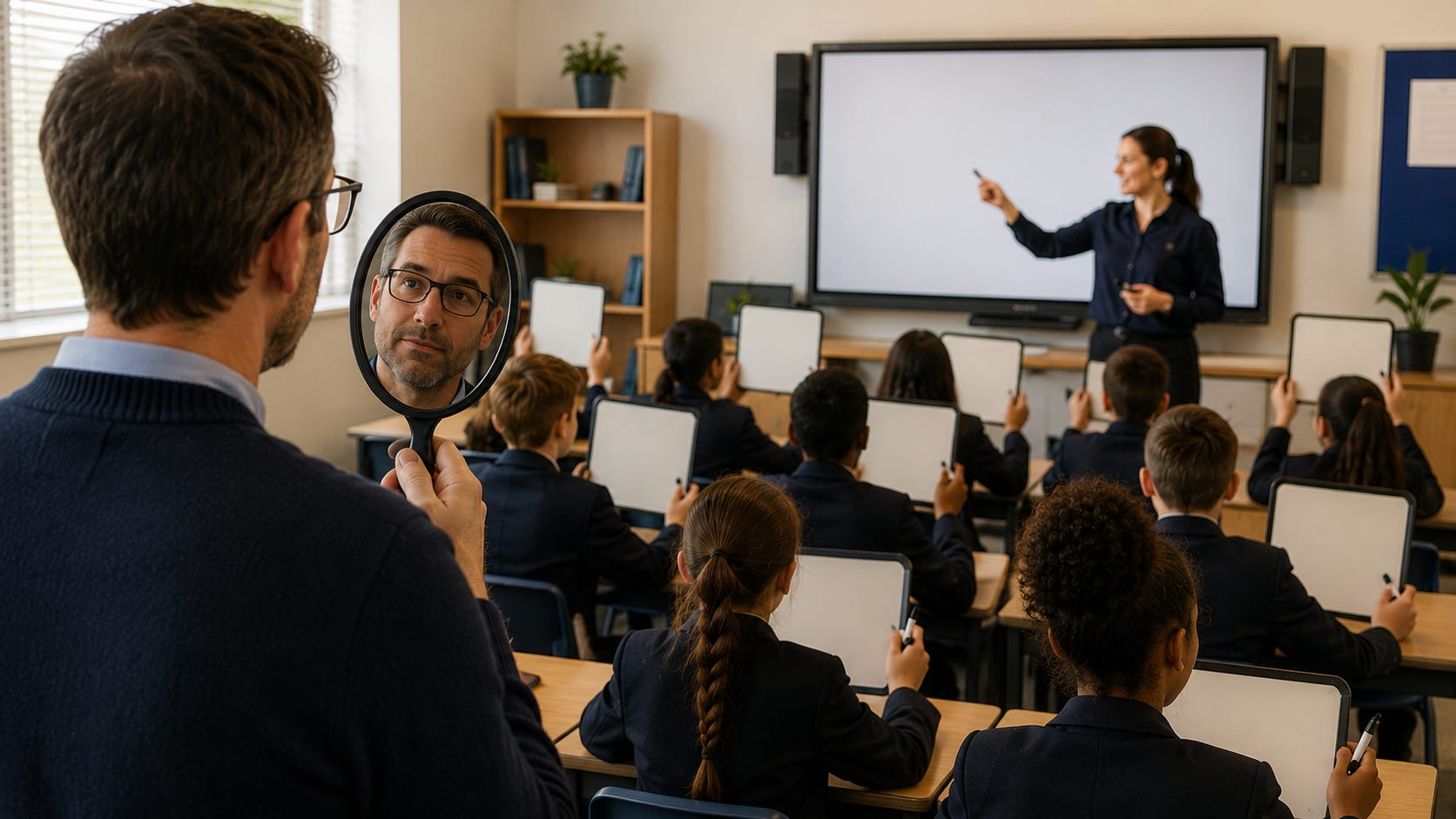
When we interview teaching candidates at Clarendon, in addition to understanding who they are and what they have to offer, we want to communicate three connected messages: we are different, we mean what we say and experienced teachers will find the first few months tough.
Perhaps we are not as different as we once were, but we are still different. We teach explicitly from shared resources—usually PowerPoint slides—that we have developed collectively over time. We have a process for refining these resources that is a focus of our meeting time. If teachers do not want to work in this way then they will be unhappy at our school and should pursue a post elsewhere. Such an outcome does not reflect poorly on them. Our approach is not suited to everyone and many fine teachers would not be happy working this way.
There are other differences, too. We don’t have many teaching assistants and we don’t spend much time ‘differentiating’ by creating multiple versions of worksheets or other resources. There is little evidence that simply adding adults to a classroom achieves anything much, despite it being a ubiquitous practice. And despite being written into various standards and policies, the evidence for differentiation is weak. Instead, we focus on whole-class teaching and our progress support team uses a response-to-intervention model where students are often withdrawn to complete discrete programs such as Corrective Maths.
The problem we face at interview is the tendency for teachers to map their previous experience onto whatever we describe. They will commonly respond that they already do the things we are talking about.
In “How Obvious”: Personal reflections on the database of educational psychology and effective teaching research, Gregory Yates writes about a related phenomenon he finds infuriating: If we give groups of teachers the task of listing some of the teaching practices that have emerged from teacher effectiveness research, they will usually fail. However, when told what these effective teaching practices are, many will claim they are ‘obvious’.
Reading Rosenshine’s Principle of Instruction for the first time, I suspect most teachers think ‘well, I review things and I break things down so I am doing that already’. In fact, many teachers have suggested to me that there is nothing ground-breaking in these principles and report being underwhelmed.
This is a problem for the diffusion of explicit teaching. Anyone who thinks explicit teaching can be a component of inquiry learning is using a quite different definition to mine and one that is most certainly at odds with Rosenshine’s Principles. But there are plenty such people out there and it is understandable why they would want to hold to this narrative. Imagine you have been teaching using inquiry for ten years and you learn that evidence supports explicit teaching. If you tell yourself you have been using explicit teaching all along then you will sleep more easily at night.
My personal journey was different to that. I left university thinking that a form of maths and science teaching I would now probably call ‘constructivist’ had the evidence to back it. No matter how hard I planned, I could never make this style of teaching work and so I quickly began to resort to chalk-and-talk. I would stand at the front, explain things, model solving problems and then set the students independent work to do.
That is a form of explicit teaching, but it does not follow Rosenshine’s Principles and it is not the form I use today.
It was when I began reading educational psychology research in around 2011 that my teaching started to change. Honestly, I was angry that I had not been aware of this research before and that anger has propelled my writing since then. But I don’t believe the research on effective teaching has been deliberately suppressed. It is more that it sits outside the bubble the vast majority of education academics and bureaucrats reside within. It would be like trying to discuss the properties of different formulations of concrete with a group of opera enthusiasts, but in a world in which the properties of concrete were highly relevant to the business of opera.
How do I teach now? In maths, I demonstrate one new concept or problem at a time and immediately ask students to respond on mini whiteboards. I spend much more time guiding practice. Instead of demonstrating three or four different problem types and setting independent practice, I demonstrate one, then we do one together, part by part, then maybe another. Only when I am certain they can chain it all together do I let them practise independently.
This ‘we do’ phase washes back into my demonstrations, too. It is rare that students are confronted with problems they cannot already do components of and so I let them do these parts on their whiteboards while I weave it together. Even though all our question slides are followed by solution slides, I rarely just present the answers. I usually work through each problem myself, thinking aloud as I do so. Instead, these solutions guide my preparation—I know what method we have agreed to use—and catch me if I’ve made a mistake. Doing mathematics while also attempting to explain it is mentally taxing and I know of few teachers who never make mistakes. If I have only found the x-value when I was asked to find the coordinates then, when I show the solution slide, I can talk about the classic mistake I have just made.
It feels far more effective than the way I used to teach. I no longer have students who cannot get started on their seatwork as I circulate around the class, re-explaining concepts and extinguishing spot fires. The progress the students make over time is highly visible. Yes, my initial motivation to teach explicitly was based on research evidence, but it is now also based on my own experience. I talk to many teachers who have had a similar journey.
However, this is hard to explain to people. They think they already do it. So, what is the solution?
This is where I believe that school visits help. We host lots of guests at my school, taking visiting teachers on a tour and popping into the back of lessons. We do not do this to tell others what to do and we certainly don’t do this to start debating the effectiveness of different teaching methods—my teachers don’t need to be backed into defending themselves when they are generously giving their time. We simply present our approach so that others can take from it as they wish. And sometimes, seeing explicit teaching in action brings home to teachers that—actually—it is not what they do already.
The benefits mean that we, too, like to visit schools and learn from them. This is a key part of our approach to professional learning.
Such an approach only makes sense in a world where there is a diversity of school types and where individual schools have some choices about what they do. It makes the variations interesting and it offers options to parents. Such a model should be supported by a far more ambitious curriculum than the Australian Curriculum and by strong, rigorous, regular, timely and defensible systems of standardised assessment that teachers, schools and—critically—parents may use to inform the choices they make.
Over on the other side of the well prepared slide deck Chris Reid is extending his whine about the evils of rigid scripts.
https://substack.com/@chrisgetcurious/note/c-276890210?r=59cba&utm_medium=ios&utm_source=notes-share-action
There are some fair points -
-the same basic structure all the time may seem dull.
- If the assumptions are not correct it would be bad to keep to the script no matter what.
But these don’t seem to be good arguments against prepared slides.
For variety- yes add some variation in the scripts. It’s got to be easier to do this with scripts than ad-hoc on your feet.
For assumptions being incorrect- well this depends the assumption failure rate.
How do you handle failed assumptions about whether the slide deck is matched to the students. Also with your approach how common is this? Is it a significant problem?
Without freedom to try other things you won’t find out novel better ways. You could tweak but end up in an evolutionary rut. But there must also be essential parts of an effective approach. Being willing to be observed often, measuring the outcome, spending time being the observer.
What else would you say is essential?